


I’m going to save you money—for free.
If you’ve ever felt that your sales numbers look good on paper but your profit margins tell a different story, you’re not alone. Many businesses discover, after a careful review, that a handful of everyday sales‑team habits are secretly costing them money. The good news? These are fixable habits, and with a few gentle tweaks you can start preserving cash today—without putting anyone on the defensive.
Below is a behind‑the‑scenes look at the five most common practices that tend to eat into your profit. Think of this as “inside information” you can share with your leadership team, your sales manager, or anyone who helps shape the way your organization sells. The goal isn’t to criticize sales professionals—far from it. It’s to give them—and you—the tools they need to sell smarter, not harder.
1. Waiting for the End‑of‑Month “Quota Sprint”
What happens:
When a rep holds a promising deal until the last few days of the month, they often feel pressured to close at any cost. That can mean offering deeper discounts, waiving fees, or agreeing to unfavorable payment terms just to hit the quota.
Why it costs you:
Reduced profit margins
Possible price‑setting precedent that customers expect in the future
A rushed hand‑off to implementation or support, which can increase post‑sale issues
Gentle fix:
Quarterly or rolling quotas flatten the pressure spikes.
Deal‑review checkpoints (e.g., a “mid‑pipeline” sign‑off) encourage reps to flag discounts early, giving finance and leadership time to weigh the impact.
Incentivize margin alongside volume—rewards that recognize both revenue and profitability keep the focus on long‑term health.
2. Relying Too Heavily on Email (and Not Picking Up the Phone)
What happens:
Emails are convenient, but they’re also slower to generate a response, especially in a crowded inbox. A prospect who receives three follow‑up emails in a week may simply “forget” your offer.
Why it costs you:
Longer sales cycles → higher cost of sales
Lower conversion rates compared with voice conversations
Missed opportunities to read tone, answer objections instantly, and build rapport
Gentle fix:
Blend email with a “phone‑first” rule: after the initial outreach, schedule a brief call within 48‑hours.
Use a sales cadence tool (like Sales Pro Gold’s automated cadence manager) to automate reminders and log call attempts, ensuring no prospect falls through the cracks.
Train reps on “effective phone scripts” that keep calls concise and value‑focused.
3. Lagging on Lead Response Time
What happens:
A prospect shows interest—maybe they fill out a form, click a demo link, or reply to a LinkedIn message. If the sales rep doesn’t respond within the first hour, the lead’s excitement fades.
Why it costs you:
Studies consistently show a 10× higher conversion rate for leads contacted within the first hour.
Delayed response lets competitors swoop in.
Your own marketing spend on the lead yields a lower ROI.
Gentle fix:
Deploy real‑time lead alerts that pop up on reps’ mobile devices the moment a prospect engages.
Set a service‑level agreement (SLA) for response time (e.g., “first contact within 30 minutes”).
Automate initial touchpoints—an instant, personalized video or a short intro email—while a human rep prepares for the next conversation.
4. Missing Cross‑Sell and Up‑Sell Opportunities
What happens:
A rep focuses solely on closing the original deal without probing for additional needs. That’s like selling a customer a single pair of shoes when they actually need a whole wardrobe.
Why it costs you:
Revenue left on the table—the average up‑sell can boost contract value by 20‑30 %.
Diminished customer lifetime value (CLV).
Missed chances to deepen the relationship, which also reduces churn.
Gentle fix:
Incorporate structured discovery questions into every call guide—questions that surface hidden pain points and future needs.
Use account‑based scoring to highlight accounts with high cross‑sell potential, then alert the appropriate rep.
Celebrate “multi‑product wins” in team meetings to reinforce the habit of looking beyond the first sale.
5. Inconsistent Follow‑Up & Poor Data Hygiene
What happens:
After a call, notes are vague, CRM fields are left blank, or follow‑up tasks aren’t scheduled. The next rep who picks up the account has to reinvent the wheel.
Why it costs you:
Wasted time duplicating research and outreach.
Lower forecast accuracy—if the pipeline data isn’t reliable, you can’t plan resources effectively.
Higher churn, because prospects feel “forgotten.”
Gentle fix:
Enforce a “one‑minute post‑call” rule: after every conversation, the rep spends 60 seconds entering key details and setting the next task.
Leverage AI‑driven data enrichment (available in Sales Pro Gold) that auto‑populates company information and suggests next steps.
Run a monthly data‑cleanse sprint—a quick, gamified session where reps earn points for updating stale records.
Turning Insight Into Savings—Without the “Hustle”
You now have a clear view of five everyday habits that may be silently eroding your profit margins. The next step is to move from awareness to action, and that’s where Sales Pro Gold can be a quiet partner:
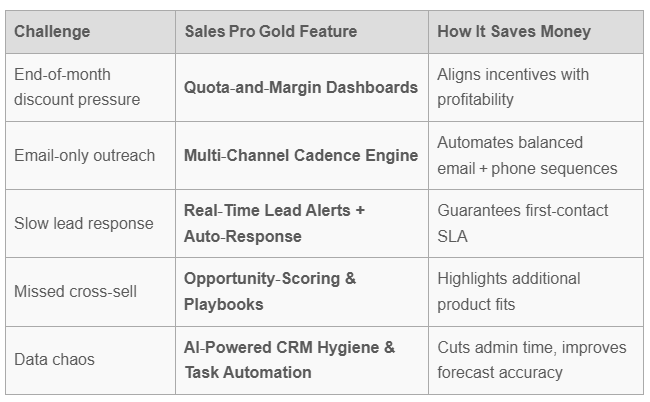
Bottom Line
Salespeople are the lifeblood of any growth‑focused company, and their expertise deserves respect. By gently nudging the process—tightening response times, balancing communication channels, rewarding margin, and ensuring clean data—you empower your team to close more deals and keep more of the profit.
Consider this your invitation to look inside the engine that drives revenue, fine‑tune the moving parts, and watch the savings roll in.
Ready to start saving money?
Schedule your free consultation with Sales Pro Gold today.
Because smarter selling should always be good for the bottom line.